TCF Canada Listening Practice — Level A1
4 TCF Canada Listening questions at level A1. Choose an answer to see whether you were right, why, and what makes each of the other options wrong.
- What you get at this level
- Very short exchanges, sometimes linked to a picture
- What is tested
- Recognizing familiar words and simple statements
In the real test, A1 questions are worth 3 points each out of 699.
Listen, then choose
Écoutez l’extrait sonore et les 4 propositions. Choisissez la bonne réponse.
The four options are read in the recording.
Choose an answer to see the explanation.
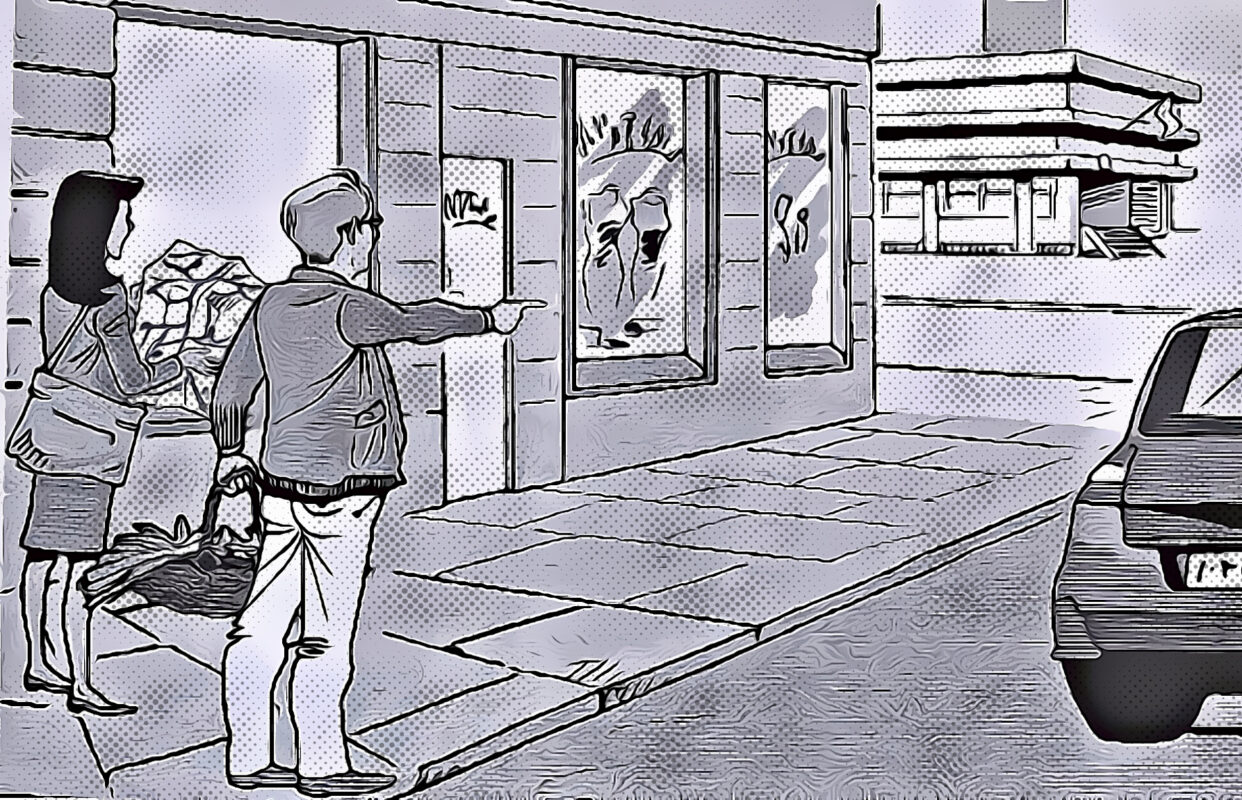
This option is correct because the audio statement, "L'entrée de la préfecture est là-bas" (The entrance to the prefecture is over there), perfectly describes the action in the image. We see a man pointing towards the entrance of a large building while speaking to a woman. His gesture directly illustrates the meaning of "là-bas" (over there), and the building is visually consistent with a "préfecture" (a public administrative building).
L'entrée de la préfecture est là-bas.
The entrance to the prefecture is over there.
The audio provides four distinct descriptions. Option A refers to a vegetable vendor, suggesting a market scene. Option B is an instruction to ask for a map, suggesting a tourist context. Option D mentions a car in a parking lot. Option C points out the entrance to the 'préfecture' (a government administrative building). Since this is the correct answer, the image associated with the question depicts a building entrance, likely with a sign indicating 'Préfecture'.
- A
This option, "C'est un bon marchand de légumes" (He's a good vegetable seller), is wrong because the man in the image is pointing at the entrance of a building, not at a person or a vegetable shop. The building's appearance is that of an official or administrative building, not a commercial store for vegetables.
- B
This option, "Demandez un plan de la ville" (Ask for a city map), is an instruction in the imperative mood. The image, however, depicts a declarative situation where a man is showing a location to a woman. His gesture of pointing is an act of indicating, not of telling someone to ask for something.
- C
This option is correct because the audio statement, "L'entrée de la préfecture est là-bas" (The entrance to the prefecture is over there), perfectly describes the action in the image. We see a man pointing towards the entrance of a large building while speaking to a woman. His gesture directly illustrates the meaning of "là-bas" (over there), and the building is visually consistent with a "préfecture" (a public administrative building).
- D
This option states, "Ma voiture est au parking" (My car is in the parking lot). This is contradicted by the image on two points. Firstly, the car is parked on the street, not in a designated "parking" (parking lot or garage). Secondly, the man is pointing at the entrance of the building, not at the car, which means the car is not the focus of his action or statement.
A. C'est un bon marchand de légumes. B. Demandez un plan de la ville. C. L'entrée de la préfecture est là-bas. D. Ma voiture est au parking.
A. He's a good vegetable seller. B. Ask for a city map. C. The entrance to the prefecture is over there. D. My car is in the parking lot.
- marchand
- merchant/seller
- légumes
- vegetables
- plan
- map
- préfecture
- prefecture (administrative headquarters)
- là-bas
- over there
Listen, then choose
Écoutez l’extrait sonore et la question. Choisissez la bonne réponse.
The four options are read in the recording.
Choose an answer to see the explanation.
The speaker asks a polite, conversational question: "vous avez passé un bon week-end ?" (did you have a good weekend?). Option D, "Oui, et vous ?" (Yes, and you?), is the only socially appropriate response. It directly answers the question with "Oui" (Yes) and then reciprocates the polite inquiry with "et vous ?" (and you?), which is a standard conversational convention.
Bonjour madame la directrice, vous avez passé un bon week-end ?
did you have a good weekend?
The audio transcript presents a social interaction: a greeting followed by a polite question regarding the past weekend ('vous avez passé un bon week-end ?'). To answer this correctly, one must confirm or deny the quality of the weekend and typically reciprocate the politeness. Option A ('Avec plaisir') is a response to an invitation. Option B ('C'est d'accord') is for reaching an agreement. Option C ('Excusez-moi') is an apology. Only Option D answers the implied Yes/No question with 'Oui' and politely asks the original speaker about their weekend ('et vous ?').
- A
The phrase "Avec plaisir" (With pleasure) is used to enthusiastically accept an offer or an invitation. It is not a logical response to the question "vous avez passé un bon week-end ?" (did you have a good weekend?), which is a polite inquiry about a past event and expects an answer about that experience.
- B
The expression "C'est d'accord" (It's okay / I agree) is used to show agreement with a proposal or a plan. It does not answer the question "vous avez passé un bon week-end ?" (did you have a good weekend?), which is a social pleasantry, not a suggestion that requires agreement.
- C
The phrase "Excusez-moi" (Excuse me) is used to apologize, to get someone's attention, or to ask for something to be repeated. It is an inappropriate and illogical response to the friendly question "vous avez passé un bon week-end ?" (did you have a good weekend?), as there is no reason to apologize in this social exchange.
- D
The speaker asks a polite, conversational question: "vous avez passé un bon week-end ?" (did you have a good weekend?). Option D, "Oui, et vous ?" (Yes, and you?), is the only socially appropriate response. It directly answers the question with "Oui" (Yes) and then reciprocates the polite inquiry with "et vous ?" (and you?), which is a standard conversational convention.
Bonjour madame la directrice, vous avez passé un bon week-end ? A. Avec plaisir. B. C'est d'accord. C. Excusez-moi. D. Oui, et vous ?
Hello, Madam Director, did you have a good weekend? A. With pleasure. B. It's agreed. C. Excuse me. D. Yes, and you?
- la directrice
- the director (female)
- passé
- spent / passed
- week-end
- weekend
Listen, then choose
Écoutez l’extrait sonore et les 4 propositions. Choisissez la bonne réponse.
The four options are read in the recording.
Choose an answer to see the explanation.
The question asks for the price of apples: "Quel est le prix de ce kilo de pommes, s'il vous plaît ?" (What is the price of this kilo of apples, please?). Option D, "Il coûte deux euros dix" (It costs two euros and ten cents), is the only logical answer as it directly states a price. The other options are incorrect because they refer to a promotion (A), the quality of the apples (B), or their location (C), none of which answer the question about the cost.
il coûte deux euros dix
What is the price of this kilo of apples, please?
The audio is a direct question asking for the price of an item. 1. Identify the question word: The phrase "Quel est le prix" means "What is the price". 2. Identify the subject: "ce kilo de pommes" (this kilo of apples). 3. Analyze the options: You need to find an answer that states a monetary value. Option A discusses a promotion (free). Option B describes a quality (sweet). Option C describes a location (aisle). Option D states a cost ("two euros ten"). 4. Conclusion: Only Option D logically answers the question about price.
- A
This option, "Le deuxième est gratuit" (The second one is free), describes a promotional offer, not the price of the item. The question specifically asks for the price, "Quel est le prix de ce kilo de pommes ?" (What is the price of this kilo of apples?), and this response does not provide a monetary value.
- B
This option, "Elles sont très sucrées" (They are very sweet), describes the quality or taste of the apples. The question is about the cost, "Quel est le prix... ?" (What is the price...?), not about the characteristics of the fruit. This response answers a question like "Comment sont les pommes ?" (What are the apples like?), not a question about price.
- C
This option, "C'est au rayon des fruits" (It's in the fruit aisle), indicates the location of the apples. The question asks for the price, "Quel est le prix... ?" (What is the price...?), not the location. This would be a logical answer to the question "Où sont les pommes ?" (Where are the apples?).
- D
The question asks for the price of apples: "Quel est le prix de ce kilo de pommes, s'il vous plaît ?" (What is the price of this kilo of apples, please?). Option D, "Il coûte deux euros dix" (It costs two euros and ten cents), is the only logical answer as it directly states a price. The other options are incorrect because they refer to a promotion (A), the quality of the apples (B), or their location (C), none of which answer the question about the cost.
Écoutez l'extrait sonore et les quatre propositions. Choisissez la bonne réponse. Quel est le prix de ce kilo de pommes, s'il vous plaît ? A. Le deuxième est gratuit. B. Elles sont très sucrées. C. C'est au rayon des fruits. D. Il coûte deux euros dix.
Listen to the audio extract and the four propositions. Choose the correct answer. What is the price of this kilogram of apples, please? A. The second one is free. B. They are very sweet. C. It's in the fruit section. D. It costs two euros ten.
- prix
- price
- pommes
- apples
- gratuit
- free
- rayon
- aisle
- coûte
- costs
Listen, then choose
Écoutez l’extrait sonore et les 4 propositions. Choisissez la bonne réponse.
The four options are read in the recording.
Choose an answer to see the explanation.
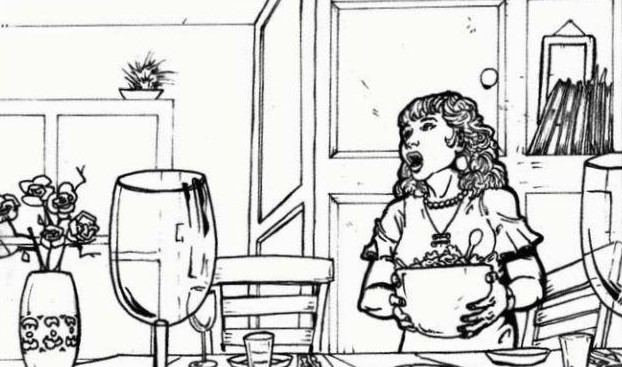
'À table !' is the standard French phrase used to call people to come and eat, perfectly matching the scene of a woman announcing a meal is ready.
À table !
To the table! / Come and eat!
The image shows a woman standing by a dining table, holding food and calling out. 'À table !' is the standard French expression to announce a meal is ready. 'Au secours' means 'Help!', 'Au lit' means 'To bed!', and 'Âllo !' is used when answering the phone — none of these fit the dining context.
- A
This option corresponds to the audio "Au secours." (Help.). This is an expression used when someone is in danger. The image does not depict a dangerous situation; it shows a woman in a dining room holding a salad bowl, seemingly calling people for a meal. Her expression is not one of fear or distress.
- B
This option corresponds to the audio "Au lit." (To bed.). This phrase is used to tell someone to go to bed. The scene in the image clearly relates to a meal, not bedtime. We can see a set dining table and the woman is holding food, which indicates it is time to eat.
- C
The image depicts a woman in a dining room setting, holding a bowl of food next to a table set for a meal. Her posture and open mouth suggest she is calling out to someone. The French expression 'À table !' (To the table!) is the standard phrase used to announce that a meal is served and to summon people to eat. This directly corresponds to the situation shown. The other options are inappropriate for the context: 'Au secours' (Help) is a cry for help, 'Au lit' (To bed) is an instruction to go to sleep, and 'Âllo !' (Hello!) is typically used when answering the telephone.
- D
This option corresponds to the audio "Âllo !" (Hello!). This is typically used when answering the telephone. The woman in the image is not on the phone; she is in a dining room, holding a bowl of food, and calling out to someone. The context is a meal, not a phone call.
A. Au secours. B. Au lit. C. À table ! D. Âllo !
A. Help. B. To bed. C. Dinner is served! D. Hello!
- À table !
- Come and eat / Meal is ready
- Au secours
- Help!
- Au lit
- To bed
- Âllo
- Hello (on the phone)